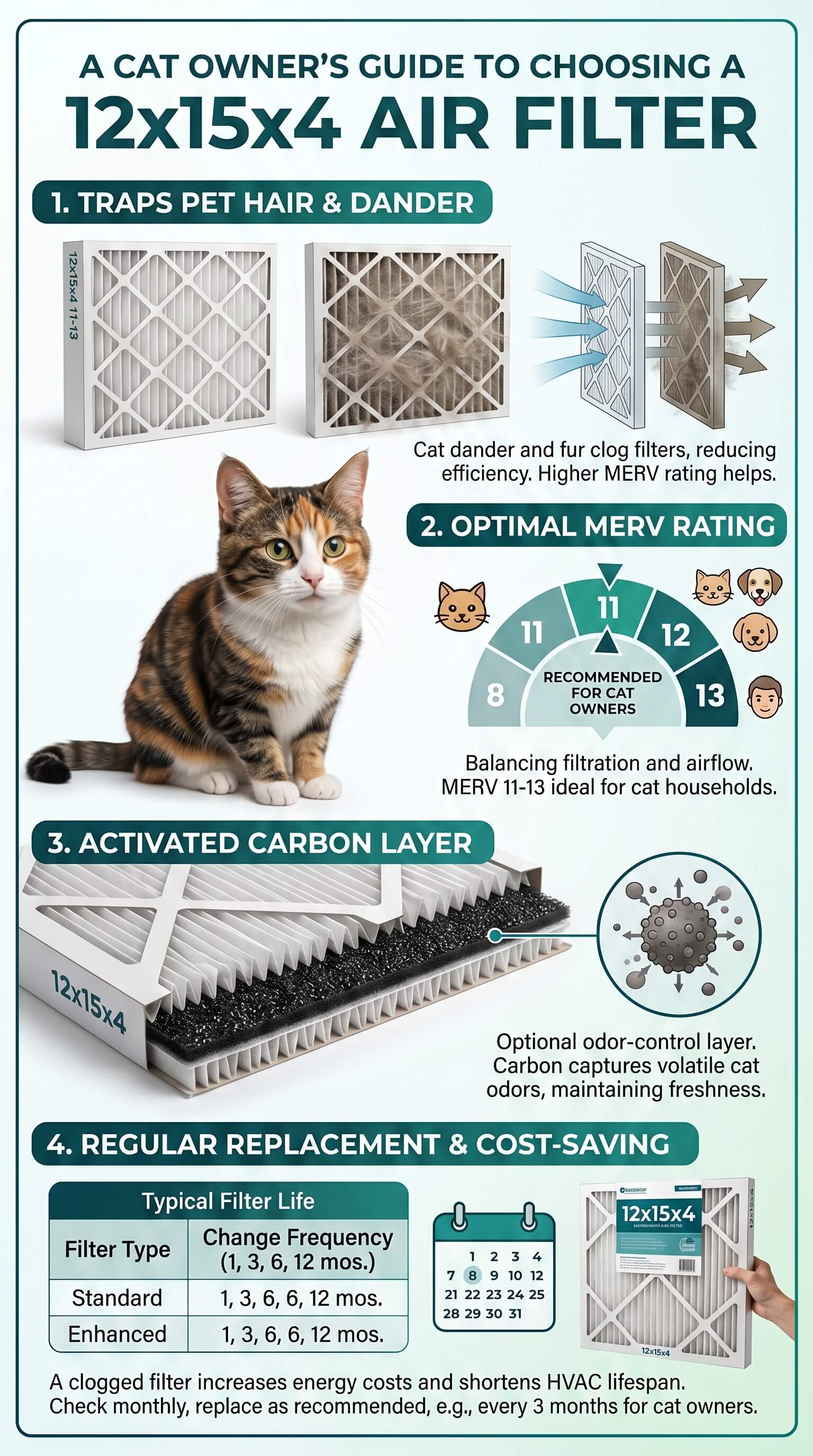
This guide walks you through what most product pages skip: which MERV rating actually catches Fel d 1 (the protein behind most cat allergies), which filter materials hold up to heavy shedding, and how often to swap filters when you've got one cat, three cats, or a household that lost count. Most filters cover the basics, but a filter sized and rated for pet households does the heavy lifting. For the technical background on how mechanical air filters trap particulate matter, the linked overview is a solid primer. Then keep reading.
TL;DR Quick Answers
12x15x4 Air Filters
A 12x15x4 air filter is a 4-inch deep pleated filter sized to fit whole-home HVAC media cabinets, and the depth is what lets it carry a higher MERV rating without choking your system's airflow. It's the right pick for homes with pets, allergies, or anyone wanting cleaner indoor air than a standard 1-inch filter delivers.
Standard MERV ratings: 8 (baseline), 11 (best for most pet homes), 13 (maximum residential filtration for allergies or multi-cat households)
Best material for cat and dog homes: pleated synthetic media
Replacement schedule: every 3 to 6 months in standard homes, every 60 to 90 days in pet households
Availability: less common in big-box stores, so direct-to-consumer manufacturers like Filterbuy produce the exact size in their American factories and ship with bulk pricing options
Top Takeaways
Cat dander, not cat hair, is the real allergen, and it circulates through your HVAC system every time the fan runs.
The 12x15x4 size's 4-inch depth lets you safely run a higher MERV rating in a pet home without choking airflow.
MERV 11 is the sweet spot for most cat households. MERV 13 is the right call for multi-cat homes and anyone with diagnosed allergies.
Pleated synthetic media outperforms fiberglass, electrostatic, and most washable options for cat households over the long run.
Replace every 60 to 90 days in a cat home. Sooner during shedding season or with three or more cats.
Buying 12x15x4 air filters in bulk on a delivery schedule keeps you on cadence and lowers your per-filter cost.
Why cat homes need a smarter approach to filtration
Cat hair grabs your attention because you can see it on the couch. The harder problem is invisible. Fel d 1, the protein responsible for most cat allergies, rides on microscopic flakes of dried skin and saliva. Those flakes cling to clothing, drift through return ducts, and recirculate every time the HVAC fan runs. The Asthma and Allergy Foundation of America points out that cat allergens are unusually sticky and easily airborne, which is why they show up in rooms a cat has never set foot in.
Why the 12x15x4 size works for pet households
The 4-inch depth is the answer to a question most cat owners haven't asked yet: how do you run a higher MERV rating without choking your airflow? A 4-inch filter packs significantly more pleated surface area than a 1-inch filter. More surface area means more places for cat hair and dander to land before pressure drop becomes a problem. The 12x15x4 size slots into common whole-home media cabinets and gives you the dust-holding capacity to run MERV 11 or MERV 13 without the system fighting back. That's why we recommend the 4-inch as the upgrade path for any cat owner currently running a 1-inch.
Choosing the right MERV rating for cats
MERV (Minimum Efficiency Reporting Value) is the EPA-recognized scale that tells you what a filter actually catches. According to EPA testing data, MERV 13 filters capture on average a minimum of 50% of particles in the 0.3-to-1.0 micron range, which is where the finest cat dander and Fel d 1 particles live. Here's the cat-specific breakdown we share with customers:
MERV 8 is baseline protection. It catches visible cat hair, larger dander particles, pollen, and standard dust. A reasonable starting point for casual cat owners with no allergy concerns in the home and a new-ish HVAC system.
MERV 11 is the sweet spot for most cat households. It catches fine dander, pollen, and mold spores. If anyone in the home has mild symptoms or you've got more than one cat, start here. Most shoppers searching for a 12x15x4 allergen air filter land in this rating.
MERV 13 is maximum residential defense. It catches the smallest dander particles, smoke, and bacteria-sized debris. Recommended for multi-cat households and anyone with diagnosed cat allergies or asthma. This is the 12x15x4 air filter for allergies most allergists would point you toward.
Material options that actually work in pet homes
Pleated synthetic media is the workhorse for cat households. It holds more debris, lasts longer, and keeps its performance consistent over the life of the filter. A 12x15x4 fiberglass air filter is the cheapest option on the shelf. It restricts airflow the least, but it also catches the least, which makes it a poor match for a cat home. We steer cat owners away from fiberglass for that reason. A 12x15x4 electrostatic air filter or the best washable air filter 12x15x4 setups appeal to a lot of people because of the reusability, but real-world performance often drops between washes, and any filter that doesn't dry fully can grow mold in humid climates. For most pet homes, a pleated MERV 11 or 13 in a 12x15x4 footprint, replaced on schedule, beats every alternative on cost-per-month and consistency.
How often cat owners should replace a 12x15x4 filter
Most 4-inch filters carry a 3-to-6-month replacement window. Cat households should plan tighter: every 60 to 90 days for one or two cats, and as often as every 45 to 60 days in multi-cat homes or during heavy shedding seasons. If you're going through filters faster than you can remember to reorder, buying a 12x15x4 air filter in bulk on a delivery schedule keeps you ahead of it.
Signs your current filter isn't keeping up
You'll usually notice the problem before your HVAC does. Cat hair gathers around vent louvers, allergy symptoms ramp up at predictable times of year, and dust on surfaces comes back within hours of cleaning. The system itself starts running longer cycles to hit the same temperature you used to reach quickly. Any one of those signals is reason enough to pull your current filter and take a look.
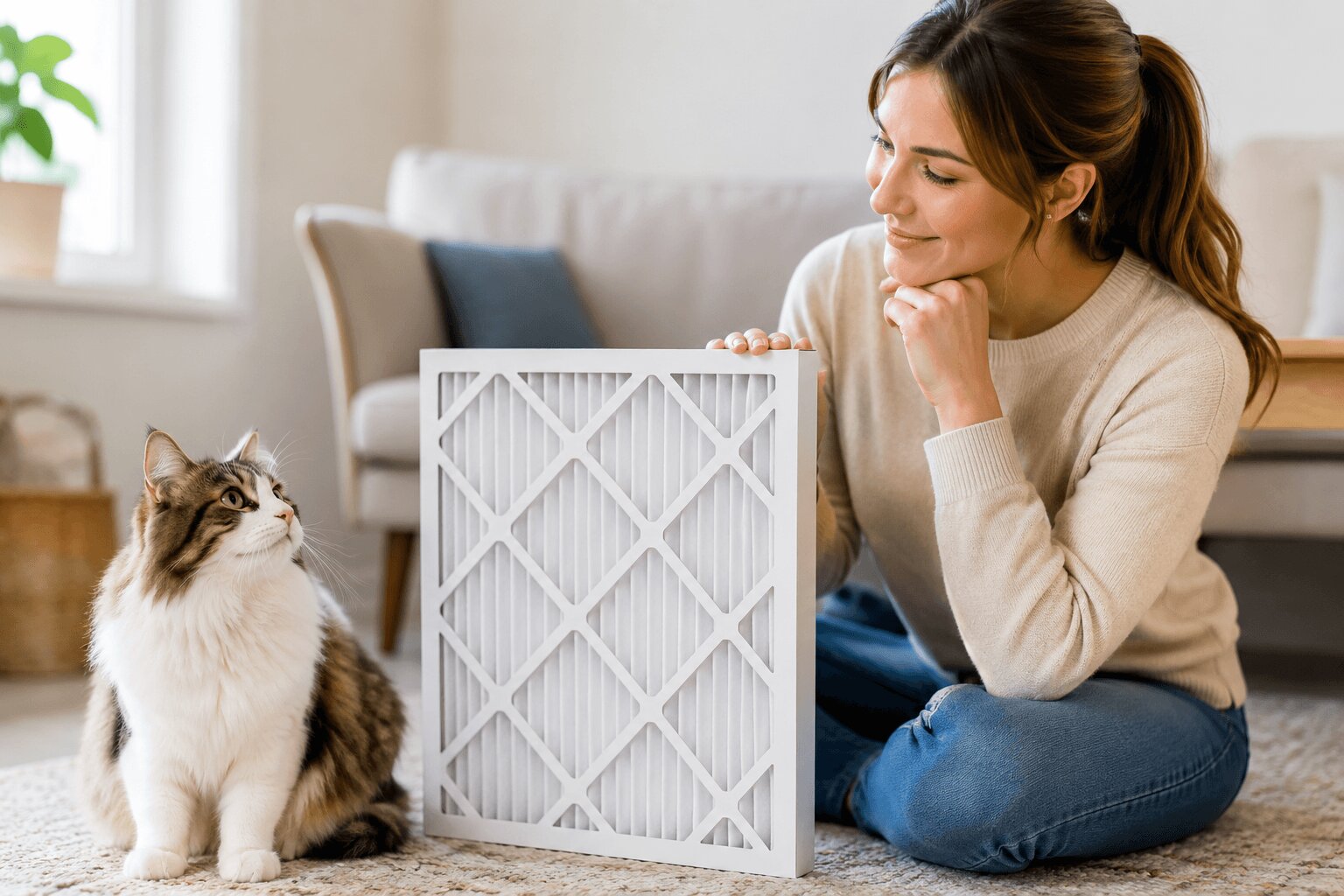
“In our manufacturing facilities, we've inspected thousands of returned 1-inch filters from cat households, and they consistently load up well before their replacement date. The 4-inch depth of a 12x15x4 is what changes that math for pet homes running MERV 11 or 13.”
— Filterbuy Air Quality Team
7 Essential Resources
Every link below points to a government, medical society, or peer-reviewed source. All URLs verified live as of May 2026.
EPA — What Is a MERV Rating? The federal explainer on how MERV is measured and what each level captures. https://www.epa.gov/indoor-air-quality-iaq/what-merv-rating
EPA — Guide to Air Cleaners in the Home. EPA consumer guidance on furnace filters, HVAC filtration, and portable cleaners. https://www.epa.gov/indoor-air-quality-iaq/guide-air-cleaners-home
AAFA — Pet Allergies (Dog & Cat). The Asthma and Allergy Foundation of America's plain-language overview of pet allergens, symptoms, and home management. https://aafa.org/allergies/types-of-allergies/pet-dog-cat-allergies/
ACAAI — Pet Allergies. American College of Allergy, Asthma and Immunology guidance on diagnosis, treatment, and reducing exposure. https://acaai.org/allergies/allergic-conditions/pet-allergies/
AAAAI — Pet Allergy. American Academy of Allergy, Asthma & Immunology resource for cat and dog allergen management. https://www.aaaai.org/conditions-treatments/allergies/pet-allergy
American Lung Association — Pet Dander. Health-focused overview of why pet dander lingers in indoor air and how to reduce it. https://www.lung.org/clean-air/indoor-air/indoor-air-pollutants/pet-dander
Mayo Clinic — Pet Allergy: Symptoms & Causes. Clinical breakdown of pet allergy symptoms, triggers, and at-home management. https://www.mayoclinic.org/diseases-conditions/pet-allergy/symptoms-causes/syc-20352192
3 Statistics Every Cat Owner Should Know
Cat allergen Fel d 1 was detected in 99.9% of U.S. homes, including homes without cats. The National Survey of Lead and Allergens in Housing sampled 831 homes nationally and found the allergen near-universal, with elevated levels carrying on clothing into non-cat-owning households. Source: J Allergy Clin Immunol / PubMed.
15% to 30% of people with allergies react to cats or dogs, and cat allergies are about twice as common as dog allergies. The Asthma and Allergy Foundation of America also notes that allergic reactions to cats can occur in places where cats have never been, because pet dander travels on clothing. Source: AAFA.
MERV 13 filters capture, on average, a minimum of 50% of particles in the 0.3-to-1.0 micron range. That's the size range that includes the finest cat dander and the Fel d 1 protein particles responsible for most cat allergy symptoms. Source: U.S. EPA.
Final Thoughts and Opinion
Here's the honest take after years of testing and tens of millions of filter shipments: most cat owners are under-filtered. Their homes run a thin 1-inch filter at MERV 6 or 8, which is a filter built for the average household, not one with a couple of dander factories sleeping on the couch. Switching to a 12x15x4 in MERV 11 or 13 isn't a luxury. It's the right baseline for the way cat homes actually breathe. The 4-inch depth is what makes the higher MERV practical: more pleat area, more dust-holding capacity, and less airflow restriction than trying to squeeze the same performance out of a 1-inch.
Will a better filter make a cat allergy disappear? No, and any brand telling you otherwise is selling something it can't deliver. What the right 12x15x4 filter does is cut the dander load circulating through your HVAC system, which is a meaningful piece of the indoor-air puzzle alongside vacuuming, washing pet bedding, and keeping at least one pet-free room in the house. Run those changes together and the air your family breathes moves from 'manageable' to 'actually feels clean.'
Frequently Asked Questions
Will a 12x15x4 air filter actually help with my cat allergies?
Yes, if you choose the right MERV rating. A 12x15x4 allergen air filter at MERV 11 catches fine dander, and MERV 13 catches the smallest Fel d 1-sized particles. The filter won't make cat allergies vanish, but it measurably reduces what's circulating in the air your family breathes day to day.
How often should I change a 12x15x4 air filter if I have cats?
Every 60 to 90 days for one or two cats. In multi-cat homes or during heavy shedding season, check the filter monthly and replace it as soon as it looks loaded.
Is a washable or electrostatic 12x15x4 a good idea for cat owners?
They sound appealing, but real-world performance is inconsistent, especially if the filter doesn't dry fully between washes, which can encourage mold growth in humid climates. For most cat households, a pleated 12x15x4 in MERV 11 or 13 is the more reliable choice.
Will a higher MERV rating cut my HVAC airflow?
It can on a 1-inch filter. The 4-inch depth of a 12x15x4 air filter largely solves the problem because the added pleat surface area lets a MERV 11 or 13 breathe much closer to a lower-MERV 1-inch. Check your system's max MERV rating in the owner's manual before any upgrade.
What's the best 12x15x4 air filter for a multi-cat household?
MERV 13 pleated synthetic, replaced every 60 days. If you've got three or more cats, set up a bulk-delivery schedule so you never run past the replacement window.
Why is 12x15x4 so hard to find in stores?
It's a less-common residential media-cabinet size, so big-box stores rarely stock it. Direct-to-consumer manufacturers like Filterbuy fill the gap by producing the exact size on demand and shipping it to your door.
Ready to Upgrade Your Cat Home's Air?
Choosing the right 12x15x4 air filter is the single highest-impact upgrade most cat owners can make for their indoor air, and we make the exact size in MERV 8, 11, and 13 right here in our American facilities. Shop 12x15x4 air filters at Filterbuy and have the right one delivered to your door.
Learn more about HVAC Care from one of our HVAC solutions branches…
Filterbuy HVAC Solutions - Miami FL - Air Conditioning Service
1300 S Miami Ave Apt 4806 Miami FL 33130
(305) 306-5027
https://maps.app.goo.gl/Ci1vrL596LhvXKU79